Next live session24 — 26 November 2026 — limited seatsReserve
Field Notes September 2026 17 min read

Two Years of Silence. Then: "Are You Available Tomorrow?"

A colleague applied to an EU operator two years ago. Two years later, out of nowhere: "Are you available tomorrow?" This industry can be incredibly slow — until the moment it becomes incredibly fast.

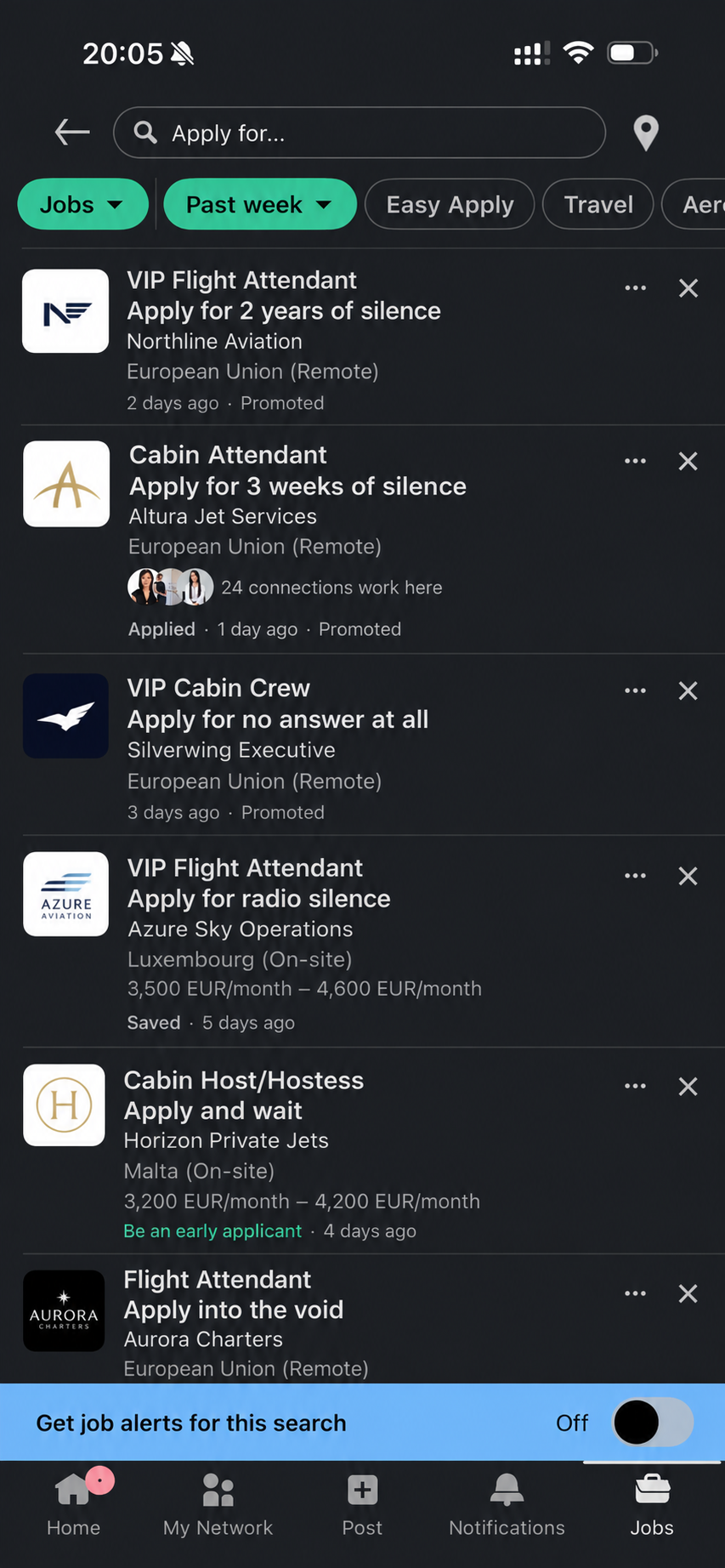
A satirical LinkedIn jobs feed listing "Apply for 2 years of silence", "Apply for radio silence", "Apply into the void" — the reality of private aviation recruitment.
The screenshot is a joke. The pattern behind it is not.

A colleague of mine applied to an EU operator two years ago. Interest came back within days. They asked for her availability, she sent it, and then nothing. Silence.

Two years later, out of nowhere, an email: "Are you available tomorrow?" She still wanted the job, so she said yes. The interview went well. Afterwards, they asked her for videos and documents. She sent everything, and then nothing again. Two years on, she has moved exactly one stage further and is otherwise back where she started.

The same thing happened to me with one of the biggest entry-point operators in this industry. Interest, then a request for availability, then silence. I never heard from them again.

Is that unprofessional, or is it just how this industry works? A bit of both. If you haven't yet, this article works alongside what to actually read in a private jet operator's contract and the €24,000 salary reality.

Silence, industry mechanics, and what you can control

Seven things worth understanding before you interpret an operator's silence as rejection.

Idea

Why requirements appear — and disappear — with almost no warning

A crew requirement in private aviation rarely comes from a perfectly planned headcount decision six months in advance. It can appear because an owner changed their mind, a budget was approved, a budget was rejected, an aircraft was added, a contract landed, someone resigned in the middle of the season, or a principal suddenly decided they wanted another crew member.

The search opens when the trigger fires, and sometimes it disappears just as quickly. In between, your file can simply sit there. Not necessarily rejected. Not progressing either.

Silence is not automatically rejection. It is often the absence of a decision that never had to be made yet.

Idea

Being male (or female) in this market — the variable nobody advertises

If you're a male cabin crew member, there is another layer to this. The market can be even narrower. Legally, sex discrimination in recruitment is generally prohibited in the EU, subject to limited exceptions, but anyone who has spent enough time around private aviation knows that the reality of owner-driven recruitment can be more complicated.

I've seen requirements where a male cabin attendant simply wasn't what the principal had in mind. Sometimes there is still an old-fashioned image of what a private flight attendant is supposed to look like, and that image is often female. You may never see that written in the job advertisement, but it can still influence what happens behind the scenes.

I've also seen the exact opposite. A male cabin attendant suddenly becomes the preferred profile because the operator doesn't consider gender important, because the crew dynamic works better that way, or because the principal's family specifically prefers it. I've seen situations where an owner's wife wasn't comfortable with, or simply didn't get along with, a female flight attendant and the operation subsequently looked for a man instead.

I'm not saying that's how recruitment should work. I'm saying I've seen it happen enough times that pretending these dynamics don't exist wouldn't help anyone trying to understand this industry.

For male cabin crew in particular, that can make the waiting game frustrating. You can have the experience, the aircraft type, the documents and the availability and still not fit a requirement for reasons that have very little to do with your ability to do the job. Then another operation appears where being male is suddenly an advantage. That's another reason not to interpret every silence as a judgement on your profile. Sometimes you aren't the wrong candidate. You're simply not what that particular principal imagined at that particular moment.

Sometimes you aren't the wrong candidate. You're simply not what that particular principal imagined at that particular moment.

Idea

What good looks like — and what operators owe candidates

Now here's the version that worked, because the contrast matters. I interviewed with another operator and suggested doing a flight test so I could see exactly what I'd be walking into before committing. They needed someone quickly and hired another candidate on the spot rather than wait for me. Fair enough. I did the flight test anyway. A few weeks later, they hired me too, with a start date three months out.

Same unpredictable industry. Completely different experience. They told me what was happening and why, they answered every question I asked, and they were transparent throughout. The delay wasn't the problem. Being left to guess is.

Understanding why private aviation recruitment works this way doesn't mean candidates should learn to accept unlimited silence. Operators are used to having a lot of choice. A vacancy can attract hundreds of applications, particularly at entry level, and over time that creates a strange dynamic where candidates start behaving as though any response from an operator is a favour. I don't think we should get used to that.

There is a difference between an unpredictable recruitment timeline and poor communication. If the position is on hold, say it's on hold. If the owner hasn't decided, say that. If the requirement disappeared, close the loop. If another candidate was selected, that's fine too. Candidates can handle a no. What is difficult to work with is having no idea whether a process still exists.

And operators should remember something too: silence builds a reputation. The VIP flight attendant world is small, people talk, and news travels fast. Candidates compare experiences, ask each other who they've interviewed with and remember the operators that treated them well — and the ones that didn't. You may have hundreds of CVs in your inbox today, but the candidate you leave without an answer could be exactly the person you want two years from now. Candidate experience works both ways.

A slow process is manageable. A silent process eventually becomes a reputation.
Idea

Why recruiters behave the way they do

Spend any time on the other side of the inbox and some of the frustration starts making sense. Recruitment in this industry is slow and painful partly because candidates don't read requirements. Worse, plenty give false information to clear the first filter. "Do you have private aviation experience?" The box gets ticked regardless because ticking it is the only way past the screening.

And yes, I hear you. Everyone wants someone with a first private aviation experience already behind them. So if nobody gives you that first chance, how exactly are you supposed to get it? That's a real problem. But lying your way through the first filter doesn't solve it. It just means recruiters stop trusting what they're reading.

AI has made this sharper, not better. Screening can now happen almost instantly, and candidates have gone to ChatGPT to write their CVs. I read a lot of them. They make the same mistakes, and after a while the giveaway becomes obvious: the same generic phrases about private aviation, luxury service, attention to detail and exceeding expectations appearing across completely different applications from completely different people. The CV sounds polished. It just doesn't sound like the person anymore.

A polished CV that no longer sounds like you is easier to spot than most candidates realise.

Idea

The mistake I see most — your CV and LinkedIn should tell the same story

Two versions of the same candidate. The CV is all aviation, as if that's the only experience that counts. Then I open their LinkedIn and discover years of other experience that belongs on the CV and isn't there. Sometimes the dates don't line up either. There are gaps on the CV that LinkedIn quietly fills in. That's one of the fastest ways to make a recruiter wonder what else doesn't add up.

Assume someone will check. When I recruit, I go through everything properly before I agree to an interview because I want to know who I'm about to spend that time with. I'm not unusual in that.

I said exactly this to a candidate on a discovery call recently. She had a genuinely strong operational background outside aviation and had hidden almost all of it because she assumed an operator only wanted to see flight hours. It made no sense. That experience was one of the strongest arguments she had.

An operator isn't only checking that you flew an A320 for a commercial airline. They're trying to work out whether you can run an operation when nobody is standing behind you telling you what to do next. Have you managed people? Handled difficult clients? Worked independently? Managed stock? Organised logistics? Solved problems with very little notice? Worked in hospitality, yachting, luxury retail, events, restaurants, hotels or another environment where discretion and anticipation mattered? If you've done something somewhere else that proves you can operate independently, it may belong on the page.

And if you come from Emirates, Qatar or Etihad, we already know you can serve — that's established the moment we read the name. You'll learn your operator's standards once you're there. So stop building your entire CV around service. This is exactly the argument I made in why we won't spend a single hour teaching plating.

The strongest line on your CV may be the one you removed because you thought it didn't count.

Idea

Stop writing "premium" — describe what you actually did

This is a small point that isn't small. Premium is a comparative word. It means the better version of a standard product, and it only has meaning against the cheaper thing it's better than. Premium economy is still economy. Premium fuel is still fuel. The word carries its own ceiling.

Luxury doesn't work in quite the same way. It isn't simply one rung higher in the same commercial hierarchy. And private aviation isn't just the upgraded version of an airline cabin. It's a different product, with different expectations and often a completely different relationship between the client, the crew and the operation.

So be careful with the language you use to position yourself. Better still, skip the adjective entirely and describe what you actually did. Specific experience is more convincing than a luxury-sounding word.

Specific experience is more convincing than a luxury-sounding adjective.

Idea

Know what you're actually applying to

This is another mistake I see constantly. People say they want to work in "private aviation" as though private aviation were one job. It isn't. You need to educate yourself about the type of operator you're approaching.

A large fleet operator, an aircraft management company, a charter operator, a corporate flight department and a single-aircraft family operation can all advertise something that looks like the same cabin crew position. The reality of those jobs can be completely different. On one operation, you might be part of a larger cabin crew structure with established procedures, catering support, clear rotations and people you can call when something goes wrong. On another, you may be the only person responsible for the entire cabin operation: provisioning, inventories, laundry, catering, menu planning, sourcing, supplier relationships, guest preferences, cabin presentation and last-minute changes in a city you've never been to before. Those are not the same job.

Before you apply, understand what you're actually applying to. Look at the operator's fleet. Understand their business model. Find out whether they're primarily charter, management, corporate or owner-focused. Then look at your own experience and ask a much better question than, "How do I get into private aviation?" Ask: "What problems would this particular operator need me to solve, and what have I already done that proves I can solve them?"

That's also why sending exactly the same private aviation CV to twenty operators makes very little sense. The aircraft might look similar. The job behind the cabin door often isn't.

"How do I get into private aviation?" is the wrong question. "What problems would this operator need me to solve?" is the right one.

The turning point

What you can — and cannot — control while the industry decides.

Stay warm, not desperate. A short check-in every couple of months can keep you present without making it look like you're chasing someone who isn't interested. Where possible, reply to the person who originally contacted you rather than repeatedly applying through the front door and resetting yourself to a stranger in the system.

But give yourself a limit too. Follow up because you want to maintain the relationship, not because your career is waiting for their permission to continue. Meanwhile, keep the boring things current: passport with real validity left on it, visas started where relevant, medical and certifications in date, references organised, documents scanned properly, everything saved in one folder you can access from your phone. Private aviation can be incredibly slow right up until the moment it becomes incredibly fast — and suddenly tomorrow actually matters.

You can't control when an owner changes their mind, when a budget gets approved, when an aircraft joins a fleet, when somebody resigns or when an operator suddenly needs someone tomorrow. You can control what they find when they look at you. That's a large part of what we work on at Gate 33 — understanding which operators fit your profile, making sure your CV and LinkedIn tell the same credible story, identifying the experience outside aviation an operator may value more than you realise, understanding the differences between operations, knowing what to have ready and preparing for the moment a conversation that has been quiet for months suddenly starts moving.

Three days, live online, with me. €600, or up to 24 payments with PayPal. If you're currently sitting in one of those silences and can't tell whether you should follow up, keep waiting or move on, book a discovery call →

The 3-Day Online Training

Control what an operator finds when they look at you.

Three live online days with Nicolas. Positioning built for specific operators, CV and LinkedIn alignment, application discipline, interview preparation — so when the email arrives asking about tomorrow, you're ready.

See the 3-Day Online Training

€600 or up to 24× payments with PayPal · Prefer one-to-one? Try the Mentorship instead.

Newsletter

Get operator news, cohort dates & career insights.

Sent by Nicolas. Low frequency, no spam — unsubscribe anytime.

Free · 15 minutes · Manually reviewed

Where does your profile actually sit today?

Twelve real-world scenarios plus three operator cases — reviewed personally by Nicolas. Written feedback on where you already stand and what still needs work before the next application.

Take the Free Readiness Assessment
Need advice?

Should you need advice from us, please feel free to reach out.

Book a Free Discovery Call