Next live session24 — 26 November 2026 — limited seatsReserve
Field Notes August 2026 14 min read

After analyzing contracts from different private jet operators, here's what you must know.

Multiple contracts, different operators. Same industry, wildly different terms — and almost none of it explained clearly to the person being asked to sign. Here's what came up, and what you should look for in yours.

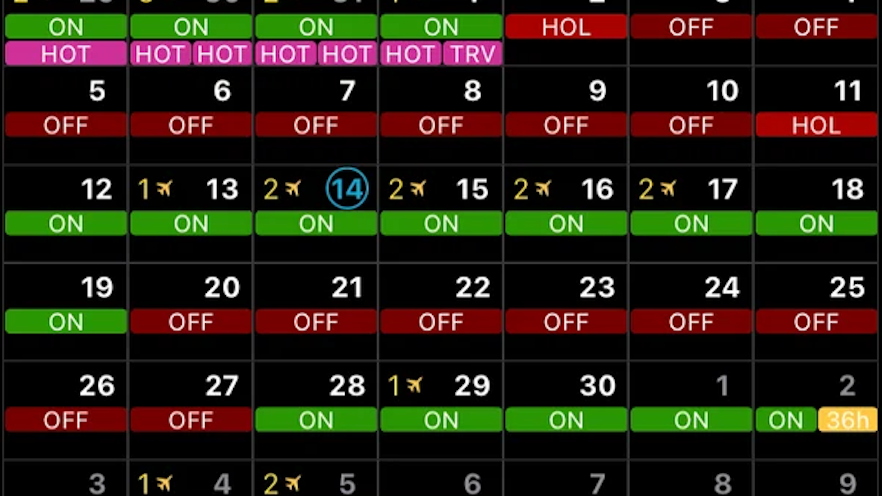
A private aviation roster calendar with ON, OFF, HOL, HOT and TRV days colour-coded.
A roster looks like a schedule. In private aviation, it can also be a legal position — read it accordingly.

Multiple contracts, different operators. Same industry, wildly different terms, and almost none of it explained clearly to the person being asked to sign. Here's what came up, and what you should look for in yours.

In commercial aviation, cabin crew are in charge of safety. That comes with real training, and it comes with a pattern you're expected to follow: emergency procedures, recurrent checks, the full weight of the role. Step outside that pattern and you get pulled aside, reported, corrected. It sounds strict, and it is. It's also what gives you rights. Not the twelve-hour forced minimum rest I lived at Qatar specifically, but a legal minimum before you can operate again — one that exists whether the company likes it or not.

Private aviation plays by a different set of rules entirely. If you haven't read it yet, this article works alongside the previous one: "EU VIP Flight Attendant at €24,000 a Year? Read This Before You Accept It."

What the contracts actually say

Six things to check before you sign anything.

Idea

Do you need the Cabin Crew Attestation?

Some EU crew hold the Cabin Crew Attestation required to operate certain aircraft types. Some hold it, but the operator simply doesn't require them to use it in their role. And some don't have it at all and can still be hired, because the company never puts them formally in charge of safety in the first place — the pilots are in charge.

That's the point where things start to get complicated, legally speaking. The same job title on paper can mean three very different legal positions once you're onboard. Ask the operator explicitly, in writing, which of these three applies to your role — and get the answer before you sign, not after.

The Attestation question is not administrative. It is the first line of your legal protection.

Idea

Duty period, rest, and the repositioning trap

If you're not considered a flight attendant in the safety sense — the pilots are — then what does that actually mean for your flight time? It means a company can schedule you to fly for the entire length of your duty period, because there's no formal limit stopping them. If the pilots are on legal rest, you probably aren't flying either, since someone still needs to fly the aircraft.

But what happens when the operator has you commute between aircraft instead, repositioning as a passenger? That's exactly where it gets tricky. In the operator's eyes you weren't flying that day, so it counts as rest. You spent it in airports and in the back of someone else's cabin, and it goes down as a day off.

Some companies have internal policies that look reasonable on paper. Short of crew, though, those policies tend to bend fast. Some push further still: landing you on what was supposed to be your day off, or starting your next duty on the last day of the one you were owed. Flexibility is genuinely part of the job. It shouldn't come at the cost of your rest. This doesn't apply to all operators.

The same creativity shows up in how some operators handle HR rules more broadly. Read your contract carefully on vacation specifically. Some operators require you to take your holiday out of your existing days off, meaning you have no separate legal vacation entitlement at all. It sounds like a technicality until you see how it plays out: they'll let you swap days off with colleagues to build a longer break, which sounds generous — and then you find you've flown six weeks straight to earn one month away. You didn't get a month of vacation. You front-loaded the work and called it leave.

Here's what that looks like in practice: nine consecutive days of flying and repositioning, no real break in between. Day ten only became a rest day because someone said out loud that they were too tired to keep going. That's the part worth sitting with: the rest wasn't scheduled, it was granted, after the fact, because a person raised it. That's not a rare edge case. It's what happens when nobody outside the operator is checking, and when the crew member in the seat has no formal duty-time protection to point to.

A rest day you had to ask for is not the same as a rest day you were entitled to.
Idea

Two contracts, side by side

Here's where the difference stops being abstract.

Contract 1. Schedule of roughly 21 to 22 working days a month against 9 days off — and only 7 of those 9 are the legally required ones. The other 2 are described as voluntarily granted, which means exactly what it sounds like. Off days get reduced further if you're sick or on vacation, at a ratio of one day lost for every three days absent. Basic salary sits at €2,500 gross a month. The duty roster comes with an explicit warning that it guarantees no planning security and can change at any time, and you're required to be reachable throughout any working day and ready at your home base within two hours. If the company needs you on one of your off days or a vacation day, that's compensated financially — a few hundred euros per day, which is fair enough, except the underlying assumption is that your days off are purchasable.

Contract 2. Different in kind, not just in degree. Crew are formally flight attendants, responsible for the safety and security of everyone in the cabin, working to a Flight Attendant Manual and standard operating procedures, with structured initial and recurrent training behind them. The safety responsibility is the job description, not a grey area. Roster pattern is 7/7. Basic salary sits at €4,200 gross a month. Vacation runs to around 30 days — a real entitlement in its own right rather than something carved out of your rest days. And there are perks that only make sense if a company sees you as part of it: space on ferry flights, including for family and friends.

Same industry. Same job title on paper. One of those contracts is buying your availability. The other is employing a professional. Neither is a scam. Both are legal. But if you're comparing two offers on monthly salary alone, you are comparing the wrong number — and the gap between these two documents is far bigger than the gap between their headline pay.

Monthly salary is a headline. The contract is the story.

Idea

What you can actually refuse — and how to raise it early

Which raises the question nobody answers clearly: what can you actually refuse? Licensed crew can decline a duty that breaches their rest, and that refusal is backed by regulation. Without that status, you're relying on your contract and on the operator's goodwill, which is a much weaker position. It doesn't mean you have no say. It means the say you have isn't automatic, and you should know that before you need it.

There's also a framing that gets lost when this is discussed as a personal grievance. A fatigued cabin attendant isn't only a wellbeing problem. In a real emergency, you're the person in the cabin. Whether the operator formally assigned you safety responsibility or not, the passengers don't know that, and it won't matter at that moment. Fatigue is an operational risk to the flight, not just to you. That's the version of the argument an operator can't dismiss as crew complaining.

So what do you do when you're already in it, not reading about it beforehand? Say something early — before you're genuinely unsafe rather than after. Put it in writing (an email or a message, not a corridor conversation) so there's a record and a timestamp. Be specific: consecutive duty days, hours, what you've actually had as rest. Raised verbally on day nine, a complaint gets you a single day. Raised earlier and in writing, it carries considerably more weight.

Fatigue is not a wellbeing complaint. It is an operational risk to the flight — frame it that way.

Idea

Position your application for the specific role

Which brings me to something I see constantly in applications. Candidates lean hard on service experience and mention safety generically, in a way that doesn't connect to the role at all. Both are missed opportunities, because these positions genuinely aren't the same.

An ACJ330 position at ComLux and a Challenger position at a smaller operator are different jobs with different requirements, and safety sits in a different place in each of them. Communicate about safety where it's actually relevant to the position you're applying for. If the role requires the attestation and formal safety responsibility, that belongs front and centre. If it doesn't, don't pad your application with it.

By the way, that's exactly the work we do in the Gate 33 mentorship program. Positioning a profile for private aviation isn't a formatting exercise. It's deciding what to lead with for a specific operator, what to leave out, and how to describe experience so it reads as operational capability rather than a list of aircraft and years.

We don't run your CV through AI. There are plenty of tools that will rewrite it into something polished and generic, and recruiters recognise that output immediately — which is worse than sending nothing at all. What we use is expertise: someone who reads these applications from the other side, knows what an ACJ330 operation asks for versus a Challenger operation, and can tell you honestly which one your profile currently fits.

Three months, one to one. Positioning, applications, interview preparation for specific operators, and contract review before you sign anything. Book a discovery call now →

A generic CV is worse than no CV. Recruiters read the same output every day and dismiss it just as fast.

Idea

Know your category before you sign anything

Even if your operator doesn't put you formally in charge of safety, you are not just service personnel. If you have previous flying experience, keep it in mind, and keep it ready. In a real emergency, that background is what tells you what to do while the flight deck is working through their own checklists. It may not be what you were formally hired for. It's still the most valuable thing you'd bring to the worst day of your career.

So know which category you fall into before you sign anything.

Are you formally in charge of safety (with the protections that come with it)?

Or are you a service professional?

Both are legitimate roles. But they are not the same job, and they don't come with the same rights — and once you've signed, that answer is no longer negotiable.

The worst day of your career is not the moment to discover which category your contract put you in.

The turning point

Three months of one-to-one work — CV, applications, interviews, contract review.

Passion gets you into aviation. Preparation is what keeps you there — and a contract read properly is part of that preparation.

That's exactly the gap the Gate 33 mentorship is built to close: three months, one to one, no AI, positioning built for specific operators, and contract review before you sign anything.

Book a discovery call →

The 3-Month Mentorship

Read your next contract before you sign it.

Three months, one to one with Nicolas. Positioning built for specific operators, application discipline, interview preparation, and contract review — so the next signature you make is one you actually understand.

See the Mentorship

Contract review included · One-to-one only · No AI rewrites

Newsletter

Get operator news, cohort dates & career insights.

Sent by Nicolas. Low frequency, no spam — unsubscribe anytime.

Free · 15 minutes · Manually reviewed

Where does your profile actually sit today?

Twelve real-world scenarios plus three operator cases — reviewed personally by Nicolas. Written feedback on where you already stand and what still needs work before the next application.

Take the Free Readiness Assessment
Need advice?

Should you need advice from us, please feel free to reach out.

Book a Free Discovery Call