Next live session24 — 26 November 2026 — limited seatsReserve
Field Notes September 2026 13 min read

13 years of cabin crew experience, and that's still not what gets you hired in business aviation.

A former colleague from my Qatar Airways years wrote to me this week. Thirteen years in aviation. Senior cabin crew. Trying to move into business aviation for months. Getting nowhere.

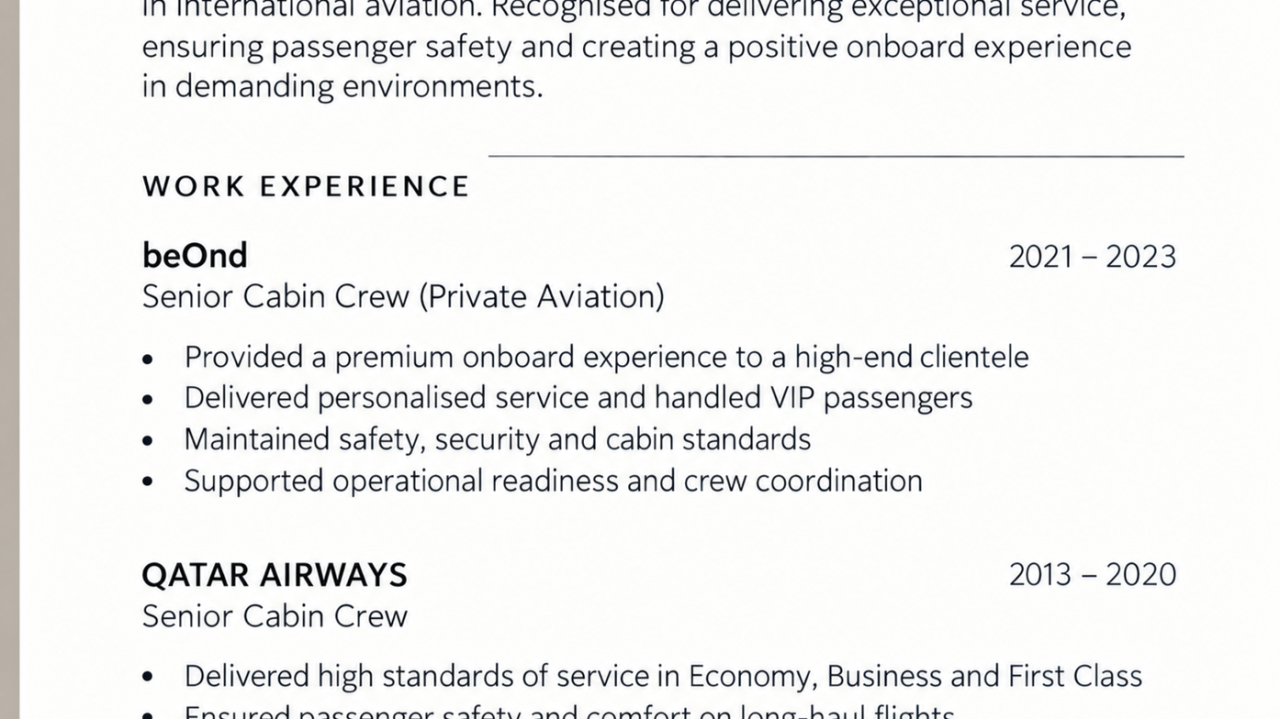
A CV excerpt showing "beOnd — Senior Cabin Crew (Private Aviation) 2021–2023" above "Qatar Airways — Senior Cabin Crew 2013–2020".
Thirteen years of cabin service. And beOnd, labelled as private aviation experience on the CV — which it isn't quite.

A former colleague from my Qatar Airways years wrote to me this week. Thirteen years in aviation, senior cabin crew, then a stretch with beOnd, the full business-class airline she now lists on her CV as private aviation experience, which it isn't quite. She's been trying to move into business aviation for months and getting nowhere, and she wanted to know where to focus.

We went back and forth. At the end of it she told me, politely and reasonably, that she didn't believe training was what stood between her and the job. Her thirteen years and her leadership experience were a strong enough foundation, and the right opportunity would come.

I understand the argument completely. I made it myself for about a year, and it cost me around 120 applications. Read the full article.

Why seniority does not open this door

The gap isn't your experience. It's the translation of it.

Idea

The assumption underneath: seniority should open the door on its own

It doesn't, and not because anyone is being unfair. A nurse with thirteen years in a hospital, running a ward, managing a team, is not automatically the right person to be the only medic on a remote expedition with no colleagues, no pharmacy and no one to escalate to. Same profession. Genuinely different job. Nobody would call that a slight on the nurse.

That's the position experienced airline crew are in when they apply to private aviation. The mistake isn't a lack of experience. It's assuming the experience transfers.

Here is what nobody tells you when you leave a major carrier: private aviation is not a smaller version of what you were doing. The service element — the part you have spent over a decade perfecting — is the smallest part of the job.

The mistake isn't a lack of experience. It's assuming the experience transfers.

Idea

The job is OPERATIONS OPERATIONS OPERATIONS

On a typical trip I am the only cabin crew member on the aircraft. That means I am the one who: places the catering order at least 48 hours out, because changes and requests keep landing inside that window, for a city I may have never landed in and where no catering company exists in any app. I'm writing this from Kyrgyzstan. Bishkek, Osh: there is no supplier list waiting for you, you build one from nothing. On a 14/14 rotation that's around ten catering orders — roughly twenty emails to FBOs and another ten to ops, most of them written on what is technically your rest.

Provisions the aircraft to be self-sufficient across a multi-day rotation, because there is no galley uplift waiting at the next stop. Builds a menu around flight duration, departure time, location, aircraft type and whatever I have been told about the guests, and adapts it when they board with their own food. Coordinates with the FBO, the handler and the crew on timings that move constantly. Manages stock control across sectors and completes post-flight reporting. Absorbs a schedule change at midnight, or a guest request that lands two hours before departure, alone, and makes it work anyway.

Which brings up something nobody mentions in an interview. In commercial, you close the flight and that's it — it's done and it belongs to someone else now. Private doesn't work that way. The trip keeps running day and night, and a good part of the coordination happens in the hours you'd call off. Not at every operator, but at plenty of them, and you should know which one you're joining before you sign. If you want to know exactly what to check, read what to actually look for in a private jet operator's contract.

Duration, location and aircraft type decide that menu before a single ingredient does. You don't have the same galley space on a Challenger that you have on a Global 7500, and you don't propose the same service for a short Paris–Nice hop that you would for a long Nice–Miami crossing. Except when the guest requests otherwise. Then none of it applies, and you make it work anyway.

The passenger sees the result. The job is everything that made the result possible.
Idea

Method, sequence, execution

I had a fifty-five-minute flight with five guests: full meal service, champagne on boarding, wine served with the meal, properly set table. Fifty-five minutes, gate to gate, alone. That is not something you improvise your way through. You need a method, a sequence you have thought about in advance and can execute while the aircraft is climbing, and enough composure that none of the pressure reaches the cabin.

Most of that is decided before anyone boards. Get the catering preparation wrong, ask for it the wrong way, have it arrive in a form that needs work you don't have time for, and a full meal on a fifty-five-minute flight simply will not be finished before landing. Not because you were slow. Because the sequence was lost hours earlier, on the ground, when the order was placed. That's the part we teach at Gate 33.

That's also the difference between operators. A decent one expects that standard and equips you for it. Plenty of others will hand you a plastic tray and consider the matter closed. Knowing how to deliver the first version, under that kind of time pressure, is exactly the sort of thing we work on.

None of that was taught to me at Qatar. It couldn't have been. At a major carrier you have a purser above you, a manual that answers most questions, an uplift already loaded, a catering department that never speaks to you, and a company standing behind every decision. That structure is precisely what makes large-scale commercial aviation work, and it is precisely why thirteen years inside it is not evidence that you can run a private cabin on your own. Not irrelevant as a professional. Irrelevant as proof of the specific thing an operator is buying.

The sequence isn't improvised at 30,000 feet. It's decided on the ground, hours earlier, when the order was placed.

Idea

What an operator is actually buying

An operator I know has hired flight attendants with no previous flying experience at all. That's not unusual. Hospitality, private households, yachting, luxury retail: people come from all of it, and some of them are among the best I've worked alongside.

That isn't an argument that experience doesn't matter. It's the clue to what does. What those people had in common is that they could already prove they'd run something alone. A household. A yacht interior. A service operation with a demanding principal and no manager to escalate to. They arrived with evidence of autonomy, discretion and judgement under pressure, and they could describe it in terms an operator recognised.

That's the currency. Not flight hours. An operator is deciding whether they can put you on an aircraft with an owner, without supervision, and trust that nothing needs fixing afterwards. Everything they read is filtered through that one question. And they test it. Put most candidates through the Gate 33 Operational Assessment without preparation and they don't pass. Operators run their own version of the same thing, and the ones that don't test you upfront will find out within your first few rotations — because inexperience in this job is visible almost immediately. There is nowhere to hide it when you are the only person in the cabin.

That's the real reason so many operators default to hiring people already working in business aviation. It isn't snobbery about your airline. They need you operational from day one, and a candidate who is already doing the job is the safest answer to that question. Which is precisely why, if you're coming from outside, you have to arrive with something better than years of service behind you.

Which is exactly why thirteen years of airline experience isn't the disadvantage it can feel like when you're being rejected. You have the substance. What you often don't have is the language for it, or the awareness of which parts of your record actually answer that question — because a structured airline environment never asked you to think about it that way. That's the gap. Not your background. The translation of it.

The currency is not flight hours. It is proof you've already run something alone.

Idea

What actually changed for me

Nothing in my background. I had years of first and business class service behind me, plus an operations role at a startup before aviation that I hadn't thought to mention on a single application.

What changed was that someone already doing the job sat down with me and helped me restructure how I presented myself. Same experience, same background, finally described in a way that answered the question operators were actually asking. Two companies hired me shortly afterwards, on material I had been sending out unsuccessfully for months.

The market isn't the problem. Honeywell's most recent Global Business Aviation Outlook projects around 8,500 new business jet deliveries over the next decade. Those aircraft will need cabin crew. The question is whether, when a chief of cabin crew spends forty seconds on your CV, anything on it tells them you could handle the aircraft alone tomorrow.

What changed wasn't my experience. It was the way I described it.

Idea

Where Gate 33 fits

I built the Gate 33 training around exactly this gap, because I had it myself and nobody would explain it to me.

It is three consecutive days, live online, directly with me. Not a recorded course. Fourteen modules covering how a private cabin is actually run: catering sourcing and ordering, provisioning, cabin setup and service flow to business aviation standards, client handling and discretion, and how to work as the only crew member on board. We also work on positioning — how your experience should read to the operators you are actually targeting.

€600, or up to 24 payments with PayPal. If you would rather establish whether it's the right thing for you first, book a free discovery call and I will go through your profile and tell you honestly — including if the answer is that you need something else, like the 3-month Mentorship.

Same experience. Different translation. That's the whole shift.

The turning point

You have the substance. What most candidates lack is the language.

Thirteen years of airline experience isn't the disadvantage it can feel like when you're being rejected. You have the substance. What you often don't have is the language for it — because a structured airline environment never asked you to think about it that way.

That's the gap Gate 33 was built to close. Three days, live online, with me. €600, or up to 24 payments with PayPal.

Book a discovery call →

The 3-Day Online Training

Translate 13 years of service into the answers an operator is actually reading.

Three live online days with Nicolas. Catering sourcing, provisioning, cabin setup, working solo on a private aircraft, and CV positioning built around what operators actually screen for.

See the 3-Day Online Training

€600 or up to 24× payments with PayPal · Next live session: 24 — 26 November 2026

Newsletter

Get operator news, cohort dates & career insights.

Sent by Nicolas. Low frequency, no spam — unsubscribe anytime.

Free · 15 minutes · Manually reviewed

Where does your profile actually sit today?

Twelve real-world scenarios plus three operator cases — reviewed personally by Nicolas. Written feedback on where you already stand and what still needs work before the next application.

Take the Free Readiness Assessment
Need advice?

Should you need advice from us, please feel free to reach out.

Book a Free Discovery Call