Next live session24 — 26 November 2026 — limited seatsReserve
Field Notes September 2026 10 min read

Every operator wants a 1st Business Aviation experience. So how do you get your 1st?

Every job ad says the same thing. Minimum one year of business aviation experience. Sometimes three. So you apply anyway and hear nothing. Here's what nobody says plainly: you are not going to be given that first experience. You are going to have to build most of it before anyone hires you. That sounds like a wall. It isn't. It's a to-do list.

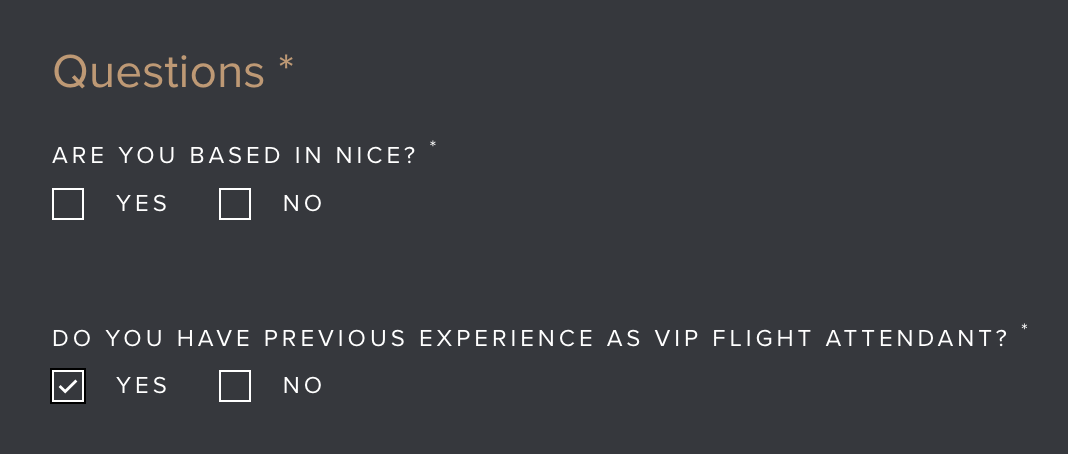
A recruitment questionnaire asking 'Are you based in Nice?' and 'Do you have previous experience as VIP flight attendant?' — the exact filter every candidate hits.
The catch: everyone asks for the experience nobody will give you first. Which is why the way in isn't applying — it's building.

Every job ad says the same thing. Minimum one year of business aviation experience. Sometimes three.

Ideally over 2 years experience in Private Aviation, especially on a Bombardier type of aircraft. Considerable experience with in-flight VIP catering orders, even in remote destinations. Native/fluent French and English speaking is mandatory. — Two years experience, for one Switzerland-based operator. That's the ad you're staring at.

So you apply anyway and hear nothing. Or you do what a lot of candidates do, and tick the box that says "yes, I have private aviation experience" to clear the screening. Don't. That box gets checked by a human, and when it fails you haven't just lost the job. You've lost the operator.

Here's the thing nobody says plainly: you are not going to be given that first experience. You are going to have to build most of it before anyone hires you.

That sounds like a wall. It isn't. It's a to-do list. Here it is.

The eight-step to-do list

How to manufacture the experience nobody will hand you.

Step

Understand what they're actually asking for.

When an operator writes "one year of business aviation experience," they're not asking for flight hours in a private cabin. They're asking for proof that you can operate alone: source catering in a city you don't know, provision an aircraft for a multi-day rotation, absorb a change with nobody to escalate to, and not need fixing afterwards.

Private aviation experience is the easiest proof of that. It is not the only one.

Read the ads carefully and you'll see some operators don't ask for flying experience at all. They ask for experience. A private household, a yacht, a luxury property, a principal's residence. For those operators, a chief stewardess coming off a superyacht can be a stronger candidate than an airline flight attendant with ten years in a commercial cabin.

Previous Flight Attendant, Cabin Server, Butler, Luxury Hospitality, or equivalent service training. Experience delivering premium customer service in private aviation, luxury hospitality, yachting, high-end hotels, fine dining, or similarly demanding service environments. — That's a real qualifications list, from a real operator. Notice what isn't in it.

Everything below is a different way of manufacturing that same proof.

Operators aren't asking for flight hours. They're asking for evidence you can operate alone. Anywhere you already do that counts.

Step

Build a real trip file, for a trip you're not flying.

This is the single most useful thing you can do this month, and it costs you nothing but time.

Take a real routing. Nice to Bishkek, three sectors, six days, four guests, one with a dietary restriction. Now actually do the work. Find out who caters at each stop, and what happens when the answer is nobody. Build the provisioning list for an aircraft that has to be self-sufficient the whole way. Write the menu for each leg, adjusted for duration and departure time. Work out the ordering timeline, and what you'd do when a request lands inside the 48-hour window.

Do that three or four times, for different aircraft and different regions, and you have something almost no candidate walking into an interview has: evidence that you understand the job. Not a certificate. Work product.

This is most of what we do in the Gate 33 training. Three days, live online, building exactly these files with someone who does it for a living and can tell you where yours falls apart. But you can start alone this weekend, you don't need me to start.

Work product beats a certificate every time. A single trip file well done tells an operator more than a résumé ever will.

Step

Learn one aircraft properly. Not five. One.

Pick the type you're most likely to be hired onto. Challenger 3500, Global 7500, whatever fits the operators near you. Learn the galley: what's in it, what isn't, how much stowage you actually have, what equipment you can and can't rely on. Learn why a full meal service works on one aircraft and fails on another.

In an interview, "I've worked on ACJ" said vaguely loses to "on a Challenger 3500 I'd handle that service this way, because the galley gives me this and not that." One is a claim. The other is the job.

Depth on one aircraft beats a name-drop of five. Interviews are won on the sentence you can finish.

Step

Collect what you can get without an employer.

Some things you cannot get until someone hires you.

Plenty you can: Food hygiene and HACCP. First aid. Wine, cheese and service fundamentals if you're weak there. Depending on where you are, the Cabin Crew Attestation — though note that many private operators don't require it, because crew there aren't formally in charge of safety.

Service is the one thing I'd tell you not to pay for. You can practise plating at home this weekend, on friends and family, using the hundreds of free videos made by people who plate professionally. And your operator will put you through their own service standard anyway, because theirs is the version that counts. We deliberately spend zero hours on it in our training for exactly that reason — the same logic I unpack in 100 VIP flight attendants, zero hours plating.

Pay for what actually gets checked. Don't pay for what your operator will overwrite in week one.

Step

Get inside the ecosystem sideways.

Plenty of people in private cabins didn't start there. They started at an FBO, in ground handling, in crew scheduling, in charter operations, or with a company that caters aircraft.

Those jobs put you in daily contact with operators, crew and owners' assistants. You learn how trips actually run. You learn the vocabulary, properly, from the inside. And you become a known name before a vacancy exists, so when one opens you aren't a CV in a pile — you're the person who sorted their catering last Tuesday.

Most first roles fill through referrals. The fastest way to become referable is to already be useful to the people doing the referring.

Step

Take the entry-level role deliberately.

Entry-level operators hire without prior business aviation experience, because their turnover means they have to. Lower salary, heavier roster, less structure.

I've written before about not accepting those terms blindly. The key word is blindly. Taken with a plan, a fixed timeframe, a clear idea of what you're there to learn and an exit in mind, eighteen months at an entry-level operator is one of the most common ways into this industry. It's also where the operational side gets learned fastest, because there is nobody else to do it. If that's the road you're on, read this first.

Entry-level is a stepping stone, not a ceiling — provided you walk in with a timeframe and walk out on it.

Step

Translate what you already have.

This is where most people lose a year.

A front office manager running late shifts alone, with authority over service recovery spend and no manager on site after 22:00, is describing autonomy under pressure. A household manager running a principal's home is describing precisely what an owner expects onboard. A chief stewardess is describing all of it.

None of that reads as relevant unless you make it read that way, and almost nobody does it themselves. It's the single thing that changed my own situation after a long run of rejections. It's also exactly what we do for Sophie in from hotel reception to private jet cabin, and it's why positioning sits inside our three days rather than being an afterthought.

If you want it done properly alongside the applications, that's what the Gate 33 mentorship is for.

Nothing invented. Same experience. Different translation. That's the shift that gets read past the forty-second mark.

Step

Have the conversation before the vacancy.

Most roles here never reach a job board. They fill through referrals, which is exactly why "apply and wait" performs so badly.

My own turning point wasn't an application. It was a conversation with a working VIP flight attendant who looked at my profile and told me the truth about it. Nothing in my background changed. Only how it was described, and two companies hired me shortly after.

Talk to people doing the job. Not to ask for a position, which puts them in an awkward spot, but to understand how they got in and how your profile reads from the inside. That's where most first opportunities actually start.

The most useful thirty minutes of your career is probably a coffee with someone already doing the job. Not an application form.

The turning point

What doesn't work.

Ticking the box. One CV sent to every operator. Waiting for a first role at a premium operator on a 7/7 roster with no experience required, because it barely exists. And assuming a service certificate will be read as private aviation experience. It won't.

If you want help doing this — three days, live online, with me. Trip files, provisioning, aircraft-specific service sequences, and positioning, so six years of the right experience finally reads that way.

Or book a free discovery call and I'll tell you honestly which of these eight steps you actually need, and which you can skip.

The 3-Day Online Training

Build the experience nobody will hand you — in three live days.

Trip files, provisioning, aircraft-specific service sequences and the positioning that finally makes six years of the right experience read that way. Three consecutive live online days with Nicolas — an active corporate flight attendant on Global & Challenger.

See the 3-Day Online Training

€600 or up to 24× payments with PayPal · Next live session: 24 — 26 November 2026

Newsletter

Get operator news, cohort dates & career insights.

Sent by Nicolas. Low frequency, no spam — unsubscribe anytime.

Free · 15 minutes · Manually reviewed

Where does your profile actually sit today?

Twelve real-world scenarios plus three operator cases — reviewed personally by Nicolas. Written feedback on where you already stand and what still needs work before the next application.

Take the Free Readiness Assessment
Need advice?

Should you need advice from us, please feel free to reach out.

Book a Free Discovery Call