Next live session24 — 26 November 2026 — limited seatsReserve
Field Notes October 2026 15 min read

€2,900 for catering, including €815 of it that was not food.

A catering quote in front of me comes to €2,900. The food on it is €2,085. The other €815 is not food, and it is not a rounding error either. It is the owner's money, spent on nothing anybody on board could see, taste or thank anyone for.

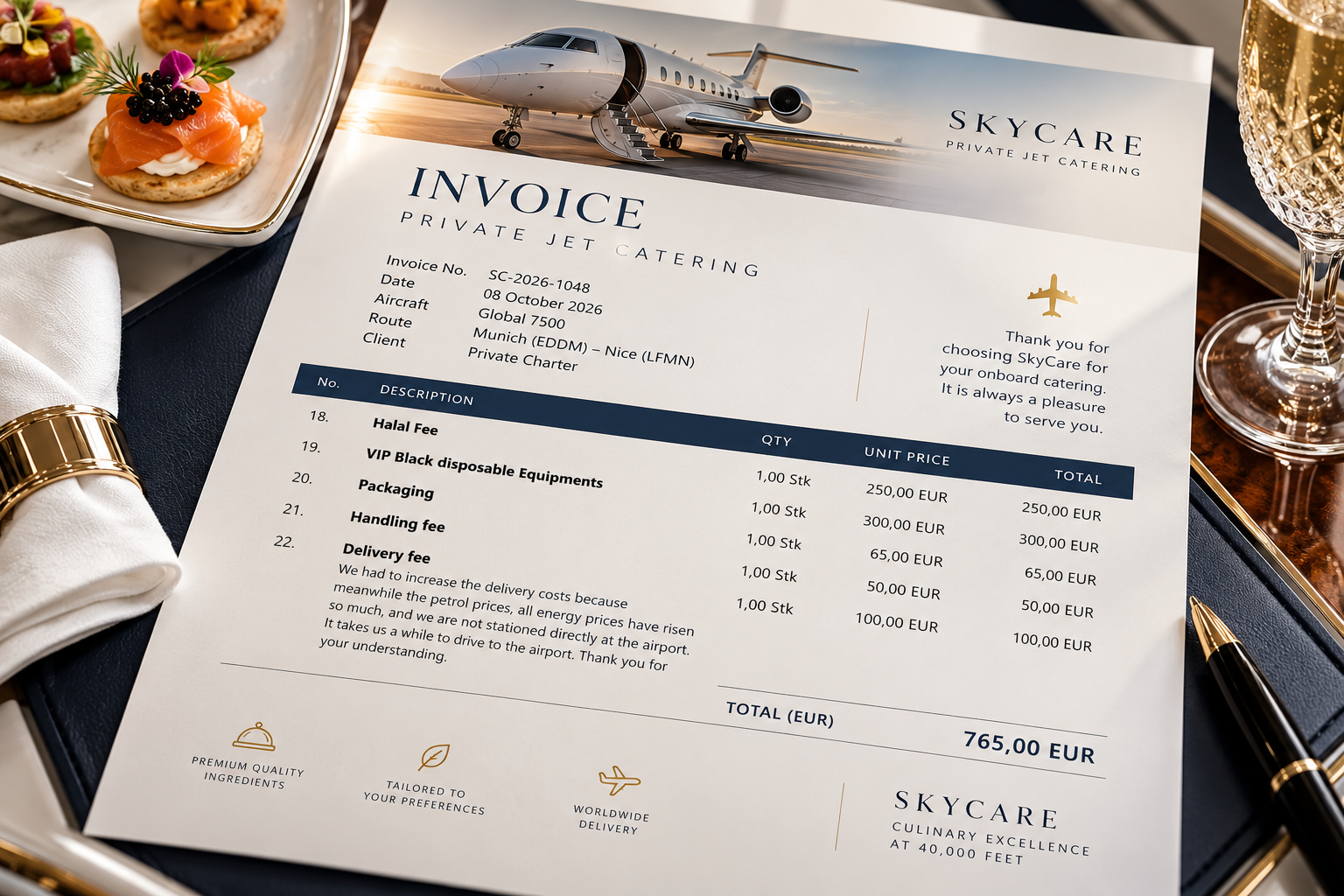
A private jet catering invoice listing a halal fee, VIP black disposable equipment, packaging, handling and delivery fees.
The bottom half of the quote: the lines nobody on board eats.

A catering quote in front of me comes to €2,900. The food on it is €2,085. The other €815 is not food, and it is not a rounding error either. It is the owner's money, spent on nothing anybody on board could see, taste or thank anyone for.

The €815 in detail:
VIP black disposable equipment: €300
Halal fee: €250
Delivery fee: €100
Packaging: €65
Handling fee: €50
Branded presentation box: €50

Now put that on a normal schedule. Two trips a week with catering on this scale is 8 orders a month: €6,520 a month, and €78,240 across a year on a single aircraft. Halve it for the lighter legs, the coffee-and-fruit-platter days, and you are still close to €39,000 a year of delivery, packaging, equipment and sourcing charges. The owner never sees €815. He sees that figure, once, in an annual report, sitting next to the hangar and the insurance. And then he asks who was placing the orders.

Reading the bottom half of the quote

Where the owner’s money goes, and how to bring it back to the guest.

Part

The part of this job nobody trains you for

Service is maybe 20% of being a corporate flight attendant. The rest is operational, and the single most consequential operational thing you do is spend money that is not yours. Nobody checks it in the moment. Nobody taught you how. And an owner will form a permanent opinion of you from it without ever raising the subject.

Here is the thing to understand before anything else. The owner is not price-sensitive. The owner is waste-sensitive. A principal who spends €14,000 on an hour of flying will still ask why there was food for 10 guests on board when only two were flying, because one of those is the product and the other is carelessness, and they can tell the difference instantly. Confusing the two is how good flight attendants get quietly replaced.

And on an owner flight there is nothing between you and that judgement. On a charter, catering sits inside a quoted price and the client rarely sees the detail. On a corporate flight there is an expense policy, a finance department, a receipt process, a system that tells you when you have stepped outside it. On an owner flight there is no system. It is his aircraft, his money, and the invoice goes to him or to the office that answers to him.

Part

Which of those lines are real costs, and which are just creative

This is the part I want to be blunt about, because nobody in this industry says it out loud. Some of those charges represent money the supplier actually spent. Others are numbers somebody decided to charge, because the person approving the quote is one tired flight attendant at 05:00 in a city they land in twice a year, with no time to compare and no authority to walk away. The test is simple and you can apply it to any quote you are ever sent: did this line cost the supplier something, or is it a price they chose because you cannot say no?

The real ones are easy to defend. Delivery at €100 is a van, a driver, fuel, the security gate and time. Halal sourcing at €250 is a genuine procurement cost. €250 might be a little excessive, but let's say it is because the supplier steps outside their normal supply chain for the order: a different butcher, a different wholesaler, sometimes a different city. Where that chain is not established at a station, that is what it costs. It is the cost of feeding the guest correctly. A night or weekend rate on kitchen staff is not a surcharge either, it is a wage.

The creative ones are a different conversation.

Packaging, €65. You are being charged for the container the food you just bought arrives in. No restaurant charges you for the plate. Everywhere else in the food industry packaging sits inside the price of the food. Here it became its own line, because here it can.

VIP black disposable equipment, €300 (yes, 3-0-0 €). Price a case of high-end black disposable trays and plates yourself, once, then look at that line again. I will not quote you a margin, because I do not have the supplier's purchase invoice and neither do you. I will tell you it is the largest non-food line on a €2,900 order, it is disposable, and nobody eats it.

Branded presentation box, €50. Fifty euros for a box with a logo on it.

A short notice fee as a flat penalty. When a late order genuinely forces a night shift or an emergency purchase, charge for it properly. When it is a flat €100 triggered because a clock passed a line in a contract, that is not a cost, it is a fine. You can tell which one you are looking at by whether the number ever changes with the situation, or never moves.

Serviceware itemised piece by piece. €15 for the basket the bread rolls sit in, €7 for each glass the dessert is served in. Individually trivial, collectively a second invoice hiding inside the first.

A service percentage taken on the total instead of on the food. Almost nobody notices this one. When a caterer applies a percentage to the whole invoice, they are taking a margin on their own delivery fee, their own packaging charge and their own handling pass-through. You are paying a markup on a markup.

The handling fee the owner pays twice. The caterer bills €50 for handling on the catering invoice. Then the handler bills for receiving the same delivery on the handling invoice, the one the pilots sign and the operator settles separately. Same boxes, same few hundred metres, two invoices. Nobody catches it, because the two documents never land on the same desk: catering goes one way, handling goes another, and the only person who ever sees both is nobody.

The markup on luxury items. The clearest case in the whole business, and the one I will put a number on below.

None of this is fraud and I am not accusing anyone of it. Catering companies in this sector carry real costs restaurants do not: tiny production runs, no stock held, fresh purchasing for every order, airport access, absurd hours, clients who change their minds at 23:00. Several of the suppliers I work with are excellent and worth every euro. But business aviation catering is one of the least price-disciplined corners of this industry, and it stays that way for one reason: the buyer is alone, under time pressure, spending money that is not theirs, and was never taught to read the bottom half of a quote. Put anybody in that position long enough and the bottom half of the quote gets longer.
Part

So go shopping

In Nice, I buy some products myself because I know what they cost through an airport supplier. For example, caviar is one of the most heavily marked-up items in this entire business. A 50g tin I buy in town for €180 arrives at the aircraft at €290 if it comes through a caterer: same producer, same tin, same 50 grams, €110 on top of the boutique's price. On one trip I needed four of them. Bought direct, €720. Through the caterer, €1,160. One order, €440 of the owner's money saved, because I walked into a shop instead of adding a line to a quote.

Everything around it I still ordered from the caterer: the blinis, the crème, the garnish, the presentation. They do that part properly and it is not worth my time to assemble it myself. The caviar is worth my time because the margin on it is indefensible. That is the judgement, and it is the whole skill. Not shop for everything. Know which two or three items on your order carry an absurd markup, buy those yourself, and let the caterer do what they are genuinely good at.

The same logic runs further than caviar. At a station you know, with time and transport, a supermarket and a good bakery can replace a large part of an order at a fraction of the price and with better produce, and with no delivery fee, no packaging charge and fruit you chose with your own hands.

I know, it is not always possible and not always appropriate. You need time and transport, and an operator who permits it. You need to be careful about food safety and traceability, because you are taking on what the caterer's paperwork would otherwise cover. Some things you cannot improvise at all: halal and kosher sourcing is exactly that, because the certification is the product and a supermarket chicken does not carry it. And sometimes there is simply no time. The brief lands late, the departure moves up, you are in a hotel 40 minutes from the city with no car, so you order everything from the caterer and the invoice is larger. That is a trade, not a mistake: the aircraft's schedule against a few hundred euros, and the schedule wins every time. The only real failure is not knowing the trade existed.

Part

And build a network of providers who price honestly

Shopping handles the individual order. What handles the other 95 orders a year is a network you build slowly, one station at a time, and the criterion you select on matters more than price.

Work with ethical providers. By which I mean suppliers whose quotes you can read, who charge for things they actually did, who tell you when a line on their own quote is not necessary for your order, and who do not reprice you because they can see you are in a hurry. They exist at every major station. They are not always the cheapest and that is not the point: a supplier who charges fairly and tells you the truth about the fish today will cost the owner less over a year than a cheaper one who adds €300 of equipment nobody asked for.

Then give them your volume, because that is the only leverage a cabin attendant has. Loyalty is what turns a vendor into a contact, and a contact behaves differently. They will not apply the short notice fee every single time, because they know you order properly as a rule and that this one is a genuine exception. They will take an order by message at 11pm and confirm it instead of treating it as an enquiry from a stranger. They will source the off-catalogue item without the punitive markup because they know you will be back next month.

Catering and provisioning is the spine of the three-day training at Gate 33, not a module at the end: live online, €600, payable in up to 24 instalments.

Going direct to a kitchen rather than through a platform is the simplest version of the same move: roughly the difference between €150 of fees and €300, and usually also the difference between seeing what you are being charged and not seeing it. Platforms are genuinely useful when you do not know a station, which is exactly the point. Every station you learn properly is a station you stop paying an intermediary for.

Around all of it, keep your own file, station by station: supplier names and direct contacts, cut-off times, delivery and handling fees, cancellation scales, who charges what for halal and kosher sourcing, where the good bakery and the good supermarket are, and which lines on each quote are standing requirements rather than defaults. None of this exists in any operator system. Operators change suppliers, crew leave and take their knowledge with them, and the station notes you inherit are usually nothing at all. The network is yours, it is portable, and after a few years it is worth more than any line on your CV, because it is the one asset the next candidate cannot copy from a template. It is also the most convincing thing you can put in front of an operator at interview.

Part

Spend where it is experienced

Spending carefully is not the same as spending less, because the money is not evenly valuable. Some of it the guest experiences directly: the food, the presentation it arrives on, the quality of the fruit, the coffee, the one dish they asked for. Spend properly there and do not negotiate with yourself about it. Some of it the guest never experiences at all: the delivery fee, the handling fee, the penalty you triggered.

So the question on every line is not whether it is expensive, it is whether it will be experienced. Move €300 out of fees and into the guest experience and you have improved the flight and reduced the invoice with the same decision. Being cheap is the opposite failure and the worse one: an owner who sees you economising on the thing they personally care about reaches a conclusion that is very hard to undo. Saving €40 on the fruit to stay under a number nobody gave you is not careful, it is a misreading of what the budget is for.

Part

Ask to see the invoice

There is a structural problem underneath all of this. On some platforms and through some arrangements the cabin attendant never sees the price at all: you build the order, you confirm it, and the invoice goes straight to the operator's accounting department. You find out what it cost weeks later, or never. You cannot be responsible for a number you are not shown, and yet the person who placed the order is the person who will be asked about it when somebody in finance finally runs the yearly figures.

So ask. Ask to be copied on the catering invoices for the aircraft you fly, and keep your own running note of what you spent per trip. Then report it without being asked: crew who report their own spend are given latitude. Crew whose invoices arrive unexplained get supervised, then asked to justify things retroactively, then managed out.

The turning point

Where that €78,000 should actually go

On a yearly basis, catering sits at 1 to 2% of an operator's total expenses, and that is the whole reason nobody has ever examined it. Two percent is a rounding error next to fuel, maintenance, insurance and crew. Nobody in finance opens a project about 2%, nobody gets promoted for fixing it, so it is approved, paid and filed. But 2% of a large number is still a large number, and a good part of this particular 2% produces nothing at all. Nobody eats a delivery fee.

Put €78,240 of non-food charges on one aircraft next to what things actually cost in this industry and it stops being a rounding error: it is roughly two mid-level cabin crew salaries in Europe. Recover even a third of it through ordering discipline, direct sourcing and honest suppliers, and that is around €26,000 a year freed up on one tail. That money has somewhere better to go. Better produce. Better presentation. A proper amenity programme. Or the thing this industry is worst at funding: paying the person who runs the cabin alone, for days at a time, what the job is actually worth.

That is why Gate 33 now works directly with operators on their catering cost and not only with crew, because the problem is structural and crew alone cannot fix all of it. The work is the same work done one level up: mapping suppliers station by station, setting ordering discipline that does not depend on who is rostered, reviewing standing requirements that have sat on every quote for years because nobody asked, giving crew visibility of what they are spending, and finding where local sourcing is both cheaper and better.

Crew or operator

Want to talk through where you are?

If you want to talk through where you are, feel free to book a free discovery call.

Book a free discovery call

45 minutes with Nicolas · No obligation.

Newsletter

Get operator news, cohort dates & career insights.

Sent by Nicolas. Low frequency, no spam — unsubscribe anytime.

Free · 15 minutes · Manually reviewed

Where does your profile actually sit today?

Twelve real-world scenarios plus three operator cases — reviewed personally by Nicolas. Written feedback on where you already stand and what still needs work before the next application.

Take the Free Readiness Assessment
Need advice?

Should you need advice from us, please feel free to reach out.

Book a Free Discovery Call