Next live session24 — 26 November 2026 — limited seatsReserve
Field Notes October 2026 13 min read

Business Aviation: The Portfolio, Your Biggest Asset

Most people making the transition into private aviation have never heard of a portfolio. It is not mentioned in the training they paid for, it is not in the advice they were given, and they only discover it exists at the worst possible moment.

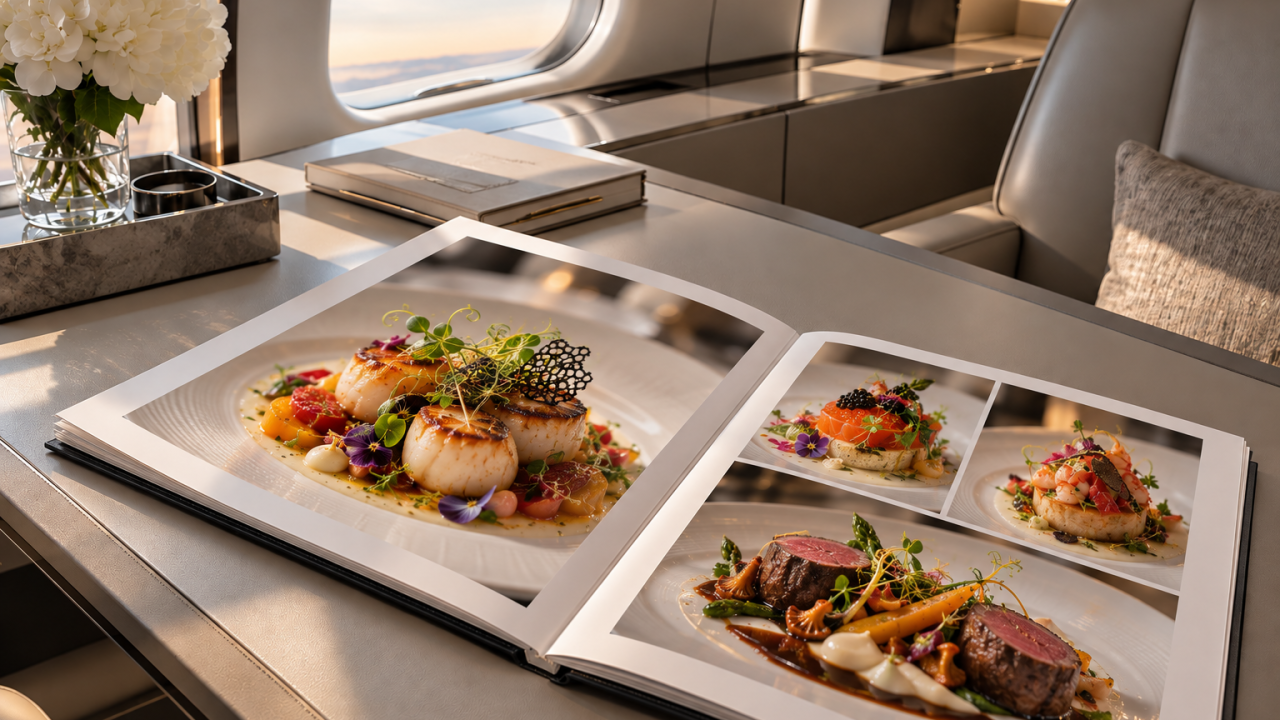
An open portfolio of plated dishes on a table inside a private jet cabin.
Gate 33 - AI Generated Visual

Most people making the transition into private aviation have never heard of a portfolio. It is not mentioned in the training they paid for, it is not in the advice they were given, and they only discover it exists at the worst possible moment.

Here is when that moment usually arrives.

Sometimes it is a positive reply to an application, which is the cruellest version. A recruiter finally answers, says the profile is interesting, and asks to see some of your work. You have nothing, and you now have a choice between a rushed document put together in an evening and an apologetic email.

Sometimes it is in a first interview, asked casually, with the same effect.

And at the top end it is written into the job description. High-entry positions, established owners: portfolio required, alongside the CV and the certificates. The pattern is consistent. The longer somebody has flown and the bigger the operator, the more likely they are to be asked for one, which tells you exactly what the document signals.

So the question is not whether to build one. It is whether you build it calmly now, or badly in one evening when somebody has finally said yes.

Building the portfolio

What operators look for, page by page.

Part

Why they ask for pictures

Because a CV cannot show a single thing about a job that is half visual.

Start with the line most candidates write: "responsible for cabin presentation and in-flight service." That sentence is on hundreds of CVs, it describes nobody in particular, and it leads nowhere. A recruiter reads it and learns nothing they had not already assumed from the job title.

Now write it properly: "in charge of catering orders and plating meals in flight." Better, and much better, because it names what you actually did rather than the area you were vaguely responsible for.

And it still does not show whether you are any good at it. A recruiter now knows you plated meals. They do not know whether your plating is clean or crowded. They do not know whether your table setting is balanced or whether the glassware sits where it should. They do not know whether a bed you make looks like a hotel or looks like a sofa with a sheet thrown over it.

That is the limit of writing. Those are the things an owner sees on every single flight, and no sentence, however well constructed, can transmit them.

An operator asking for photographs is not being difficult. They are trying to answer a question your CV left open.

Part

What it should look like

Before the content, the look, because this is where most portfolios fail before anybody reads a word.

Make it look like the aircraft, not like a presentation. Private jet interiors are cream, bone, taupe, dark wood, brushed metal. They are quiet. Nothing in that cabin is trying to get your attention, and your portfolio should not either.

So: ivory or off-white pages, black or charcoal text, one serif typeface throughout, generous white space, and photographs allowed to sit large and uninterrupted. No gradients, no coloured blocks, no icons, no stock graphics of aircraft silhouettes, no bright accent colour chosen because it felt modern. If the document looks like a marketing deck, it reads as somebody selling themselves. If it looks like a quiet, well-made object, it reads as somebody who understands the standard they are applying to.

The test is simple. Put your portfolio next to a photograph of the cabin you want to work in. If the two look like they belong in different industries, start again.

Part

The structure, page by page: who you are

Cover. Your name. Nothing else, or almost nothing. No title, no slogan, no logo you made for yourself. White space and a name, the way a good menu card looks.

Your photograph. One professional portrait, groomed as you would arrive on the day, uniform or neutral business dress, plain background, no filters, no holiday pictures (these casual pictures may be asked by some operators, mostly in the Middle East). This is a presentation industry and they will see you eventually, so there is no advantage in making them wait. Nobody is assessing you as a model. They are checking you understand the standard you are presenting yourself to.

Summary. Four or five lines. Who you are, what you are moving from, what you are moving towards. Written in your own words, not polished into the generic by a chatbot.

Experience. Short. The portfolio is not a second CV, so this is a list that gives context to the images: roles, operators or establishments, aircraft types if any, years. Three or four lines per entry at most.

Part

The cabin: table, flowers, drinks

Welcome table. The table as a guest finds it on boarding. Linen straight, glassware placed, cutlery aligned, a small arrangement if that is the standard you work to, nothing crowded. The first thing a principal sees when they step on board, and the easiest thing in this job to do carelessly.

Flowers. A small arrangement photographed on its own, because it is a genuine skill with genuine constraints and almost nobody shows it. On an aircraft an arrangement has to be low enough not to sit in a sight line, stable enough to survive taxi and turbulence, and scentless enough not to fill a sealed cabin or trouble somebody with an allergy. It also has to look like it belongs in that particular interior rather than in a hotel lobby. Show one you built yourself, in the palette of a cabin, and you have demonstrated taste and practical judgement in a single photograph. Please avoid tinted flowers like blue tinted roses. Also avoid butterfly decorations or any kind of odd decoration that does not belong on a jet.

Drink preparation. Underused by candidates and genuinely useful to show. Coffee made properly and presented, a tea service, a cocktail built and garnished, wine opened and poured, water service with ice and citrus done cleanly. It demonstrates a part of the job that happens on every single flight, including the short ones where no food is served at all.

Part

Menu examples

Not one menu. Two or three, built for different flight profiles, because a single menu only proves you can write a dish list while a set of them proves you understand what the aircraft and the clock allow.

A menu in this industry is not designed around what sounds impressive. It is designed around four constraints: flight time, departure hour, galley equipment or aircraft type, and guest count. Show that you know that, and you have said more about your operational thinking than any paragraph of your CV.

Give each menu a header stating the brief it answers, then the menu itself as you would present it to the guest:

1h15, 2 guests, 07:00 departure. No cooking on board, nothing that needs a knife while the cabin is still climbing. Fresh fruit, warm pastries, Greek yoghurt with honey, a plated omelette prepared on the ground, coffee made properly. One page, four lines, finished before top of descent.

3h30, 4 guests, midday. One proper course, executable in a galley with a single oven. A cold starter plated in advance, a main that reheats without drying, a dessert served at room temperature. The most common profile in Europe and the one worth mastering.

11h, 2 guests, 21:00 departure. Light at the start because they want to sleep, then something correct available at any hour of the night. A supper rather than a dinner, a breakfast held ready for whenever they wake, and nothing that has to be eaten at a fixed time.

Then one line under each: what you would cut first if the flight time shortened, and what you would carry from base rather than source at destination.

Three short menus, one page, and a recruiter can see that you build a service around the conditions rather than around the ingredients.

Part

Plating

The single most revealing image in the whole document, and the one operators look at first.

Two things are being assessed here. The first is standard: proportion, restraint, and the edge of the plate, because a smeared rim says more than three paragraphs of your CV. The second, and the one candidates never think about, is creativity. An operator wants to see whether you have an eye. Whether you can take four ordinary components and arrange them so the plate looks considered rather than assembled. Whether you bring something of your own to a dish instead of reproducing a photograph you saw somewhere.

That matters because in a galley you will almost never have exactly what the plan called for. Something will be missing, something will not have travelled well, and what you do in that moment is a creative decision made in 10 minutes with no one to consult. The plating photograph is the only evidence in your whole application that you can make that decision well.

So do not shoot an elaborate restaurant plate, because that is not what happens on an aircraft. Shoot a clean, well-composed dish on the kind of plate an aircraft actually carries, from above, in daylight, and make the composition yours.

Part

The service sequence

One flight, written out as a timeline. Welcome drink and canapés and hot towel at boarding, menu once the seatbelt sign is off, starter at 40 minutes, main at 1 hour 20, cheese and dessert, coffee and digestif, cabin cleared and reset before descent. Then one line on what moves if the departure slips an hour, and one on what you do if the guest sleeps through the first service.

This is the page that separates somebody who can plate from somebody who can run a cabin. A dish is a single task. A sequence shows you know how long each step takes in a galley with one oven, how much time you need between courses when there is nobody to help, and which course you cut first when the flight time shortens by 40 minutes. Operators read it as evidence that you plan rather than react, and almost nobody includes one.

Part

Bed preparation and the wellness moment

Bed preparation. Underestimated by candidates and watched closely by operators, because a divan converted into a bed has a right and a wrong answer. Corners, tension, the fall of the blanket, how the pillows sit, whether the result looks like somewhere a person would want to sleep after 11 hours.

The wellness moment. The part of the job that separates service from hospitality, and the part candidates almost never put in a portfolio.

If you offer anything beyond food and drink, show it. A night kit laid out: slippers, eye mask, water, the amenity set, arranged rather than dumped. Pyjamas folded and presented the way you would leave them on a turned-down bed. A face mask or a skincare set offered on a long sector. A hot towel service. A tray prepared for a guest who wants to sleep in 20 minutes rather than eat.

What this shows an operator is that you think about the guest's whole journey rather than their next meal. On an 11-hour sector, the food is 90 minutes of it. Everything else is comfort, and the crew who have thought about comfort in advance are visibly different from the crew improvising it at hour 6.

Part

Aircraft experience and certifications

Aircraft experience. If you have flown, this is where it goes: types, cabin configurations, galley equipment you have worked with, route profiles, typical guest numbers. If you have not flown yet, leave the section out entirely rather than padding it. An absent section is honest. A thin one is an admission.

Certifications. Cabin crew attestation, safety and emergency procedures, first aid, food hygiene, dangerous goods, any aircraft-specific or service training. Issuing body, date, validity. Plain text, verifiable facts, no icons.

Part

If you are starting out, you still have everything you need

The most common objection is that you cannot build a portfolio without an aircraft. You can, and the operators asking for one know that perfectly well.

You do not need a cabin. You need a table, daylight, and a standard. Plate a dish at home on a good plate, in a clean setting, and photograph it properly. Set a table the way you would set it on board. Make a bed. Build a cocktail and shoot it. Write the menu you would serve on a two-leg day for two guests with one dietary restriction and no oven.

Shot honestly and labelled for what it is, that work is assessed on exactly the same criteria as work done on board, because the criteria are proportion, standard and judgement, not location.

And do not use AI images. Not for a cabin you have never been in, not for a dish you never plated. Generated interiors and generated food are recognisable, more so every month, and the moment a recruiter suspects one image, they stop believing the whole document, including the parts that were real. A genuine photograph of a table in your own kitchen is worth more than a flawless render of a cabin you have never seen.

Part

What to leave out, and this one is not optional

Anything involving a real guest. No photographs taken in a cabin with people or their belongings in frame. No registrations, no names, no routings tied to a date, no screenshots of a flight brief.

Discretion is a hiring criterion in this industry, and a portfolio that breaks it disqualifies you faster than a weak CV ever could, because it is evidence of judgement rather than an absence of experience.

Part

Format

One PDF. Under 10MB so it is sent by email, not by WeTransfer. Named with your family name and the word portfolio, so it is findable in a recruiter's downloads folder three weeks later rather than sitting there as "document-final-v4". Link it from your CV as a single line, and do not attach it unless it was asked for.

The turning point

Why it works at all

Operators hire cabin crew on trust, with very little information and very little time. They are deciding whether to put you on an aircraft, alone, with their client's privacy and their owner's money.

A CV asks them to take your word for it. A portfolio lets them look.

Where portfolios get built

Want to talk through what yours should contain?

Building one properly takes feedback rather than instruction, which is why it sits inside the three-month mentorship at €2,200 rather than in a module. If you want to talk through what yours should contain, do not hesitate to schedule a call with me.

Book a free discovery call

Three-month mentorship · €2,200 · portfolio built with feedback.

Newsletter

Get operator news, cohort dates & career insights.

Sent by Nicolas. Low frequency, no spam — unsubscribe anytime.

Free · 15 minutes · Manually reviewed

Where does your profile actually sit today?

Twelve real-world scenarios plus three operator cases — reviewed personally by Nicolas. Written feedback on where you already stand and what still needs work before the next application.

Take the Free Readiness Assessment
Need advice?

Should you need advice from us, please feel free to reach out.

Book a Free Discovery Call